westcoastcosmos.com

About The Elephant Trunk Nebula

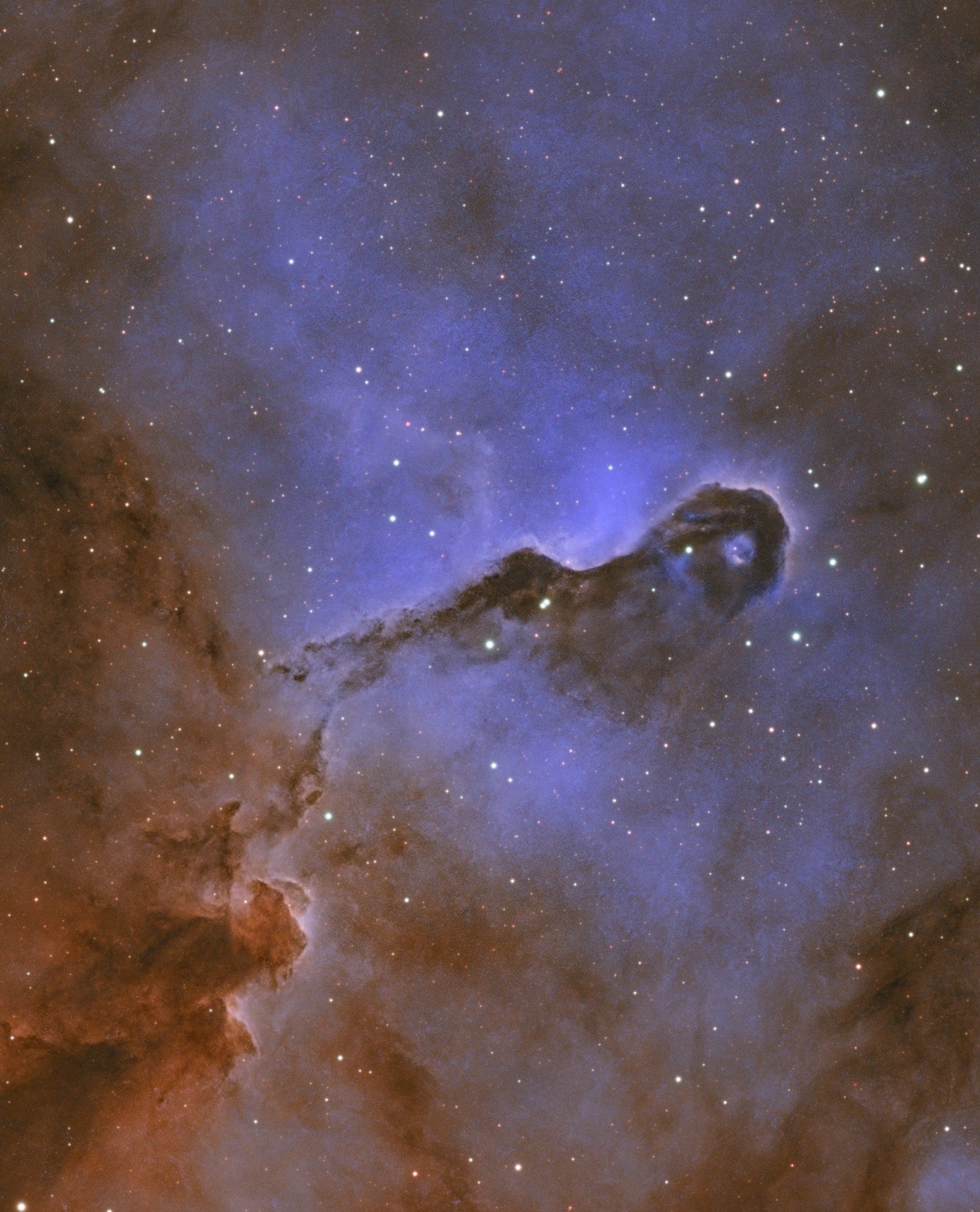
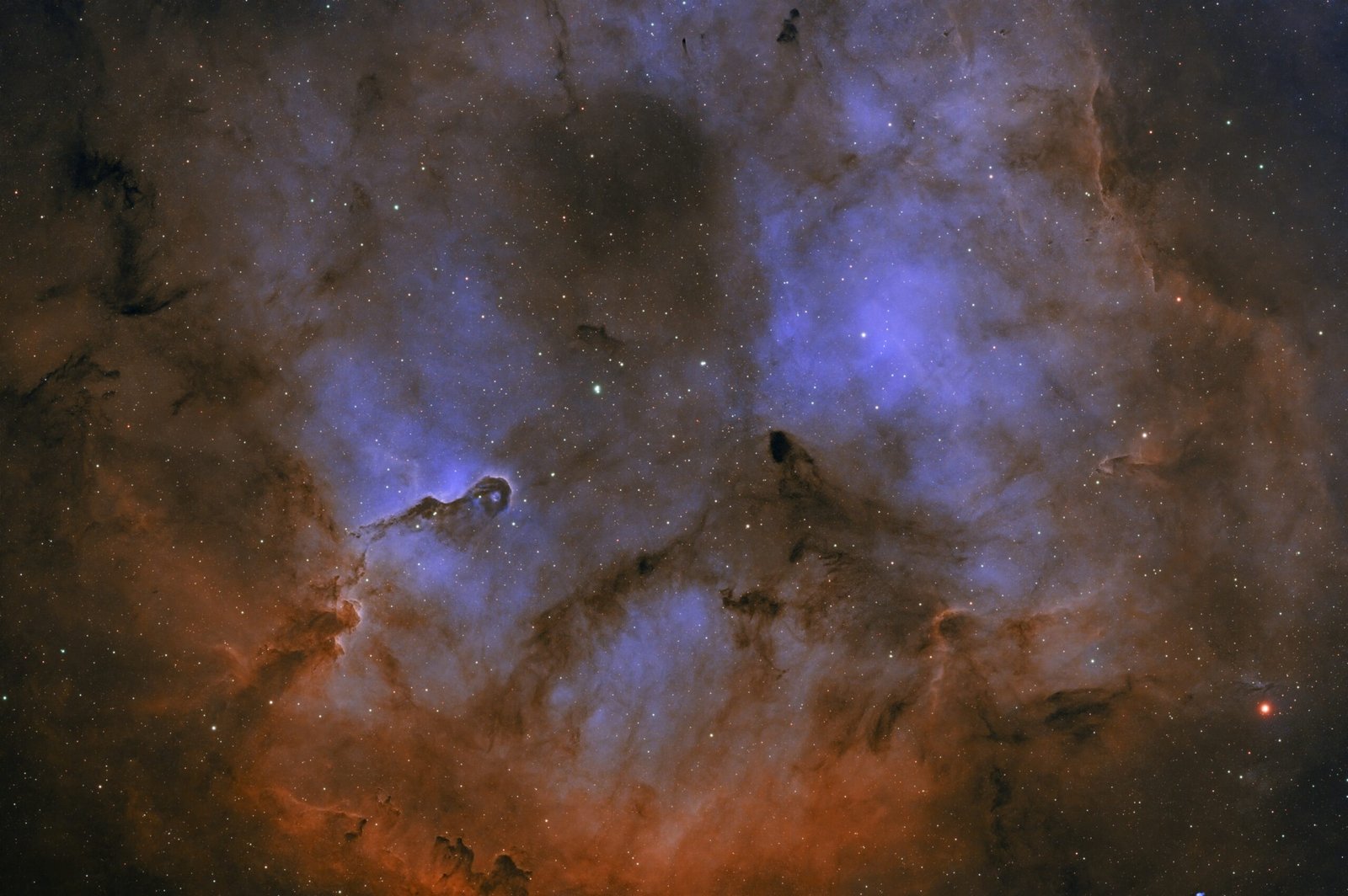
The Elephant's Trunk Nebula (IC 1396A) was a target that immediately caught my attention because of its incredible structure and shape. The twisting pillars of gas and dust, combined with the intricate textures and layers throughout the region, make it a fascinating object to photograph. The more you look, the more detail seems to emerge from the clouds.Located in the constellation of Cepheus, around 2,450–3,000 light-years from Earth, the nebula is part of the much larger IC 1396 emission region. That means the light captured in this image began its journey towards us thousands of years ago.Beyond its striking appearance, the Elephant's Trunk is also a stellar nursery. Its dense clouds contain the raw material needed to form new stars, with young protostars hidden deep within the dust. Radiation and powerful stellar winds from nearby massive stars are gradually sculpting the surrounding material, creating the bright ridges and dark, intricate structures that make this nebula so distinctive. It is a remarkable combination of creation and destruction, captured in a single region of the night sky.

Capturing

The Elephant Trunk Nebula was captured over five nights during June and July 2026, when the summer skies offered only short windows of true darkness. This meant several late nights and making the most of every available opportunity, with the brightness of the night sky limiting how much useful data I could collect each session.As one of my first proper deep-sky targets, it was also a steep learning curve. Combining data from multiple nights meant learning how to frame the target consistently each time, ensuring the images aligned properly and could be combined into a single final image. Getting the same composition night after night was a challenge, but an important step in developing my astrophotography skills.In total, I captured 113 exposures of 180 seconds each, giving 5 hours and 39 minutes of total integration time. Every exposure added another small piece of detail, gradually building up the final image.

Equipment Used

The image was captured using an Askar 71F telescope at 490mm focal length, mounted on a Sky-Watcher EQ-AL55i PRO. Imaging was performed with a cooled ZWO ASI2600MC P colour camera and ZWO DB2 Duo-Band filter.

Guiding was provided by a ZWO 30mm F5 APO Mini Guide Scope, with acquisition and mount control handled through the ZWO ASIAIR Mini.

Processing

The image was stacked and processed in PixInsight, with this being my fifth attempt at processing the data. After experimenting with several different workflows, I settled on an approach that allowed me to bring out the intricate structure of the Elephant Trunk Nebula while controlling noise, preserving detail and balancing the colours.

1. Colour Calibration and Gradient Correction

I began with Spectrophotometric Colour Calibration (SPCC) to establish a natural colour balance. A light application of gradient correction followed to address uneven background illumination while preserving the faint nebulosity.

2. Initial Noise Reduction and BlurXTerminator

I applied RC-Astro BlurXTerminator using the Correct Only setting to address optical and imaging distortions without applying sharpening at this stage. RC-Astro NoiseXTerminator was then used with an initial strength setting of 30 to reduce noise while retaining the finer structures within the nebula.

3. Star Removal and Separate Processing

RC-Astro StarXTerminator was used to separate the stars from the nebula, allowing both elements to be processed independently.

I stretched the star layer using the Seti Astro Star Stretch script, aiming to reveal the stars without allowing them to dominate the image. The starless nebula was stretched separately using the Seti Astro Statistical Stretch script, bringing out the faint structures and subtle variations in brightness within the gas and dust.

4. Narrowband Colour Enhancement

I used Narrowband Normalisation to adjust the relative contribution of the narrowband channels, including an OIII boost to enhance the blue-green emission. Selective colour masks allowed individual regions and colour channels to be adjusted without significantly affecting the rest of the image.

Curves adjustments were then applied to each colour to refine the balance, contrast and saturation, bringing out the complex colours and textures that make this target so distinctive.

5. Further Noise Reduction and Final Sharpening

A second pass of RC-Astro NoiseXTerminator was applied, using a strength setting of 80 to further control residual noise following the stretching and colour adjustments.

Finally, BlurXTerminator was used again to sharpen the non-stellar objects, enhancing the finer structures and definition within the nebula.

The final result represents the fifth processing attempt, following several different workflows and adjustments. Each iteration helped refine the balance between detail, colour, noise and contrast, with the aim of revealing as much of the Elephant Trunk Nebula’s intricate structure as possible.

Close Up

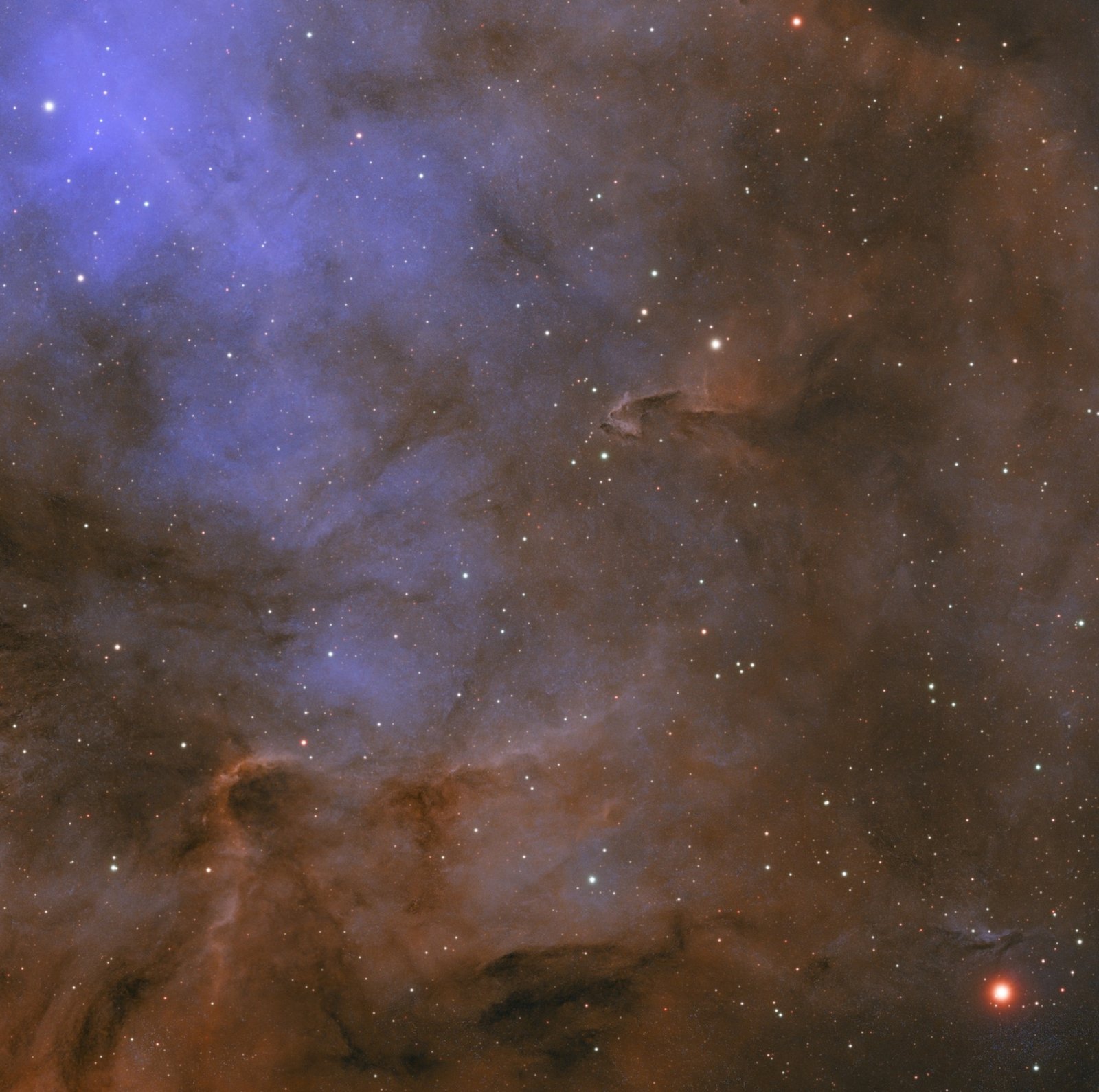
Detailed crops and close-up views highlighting features within the final image. Click on each one for more detail.