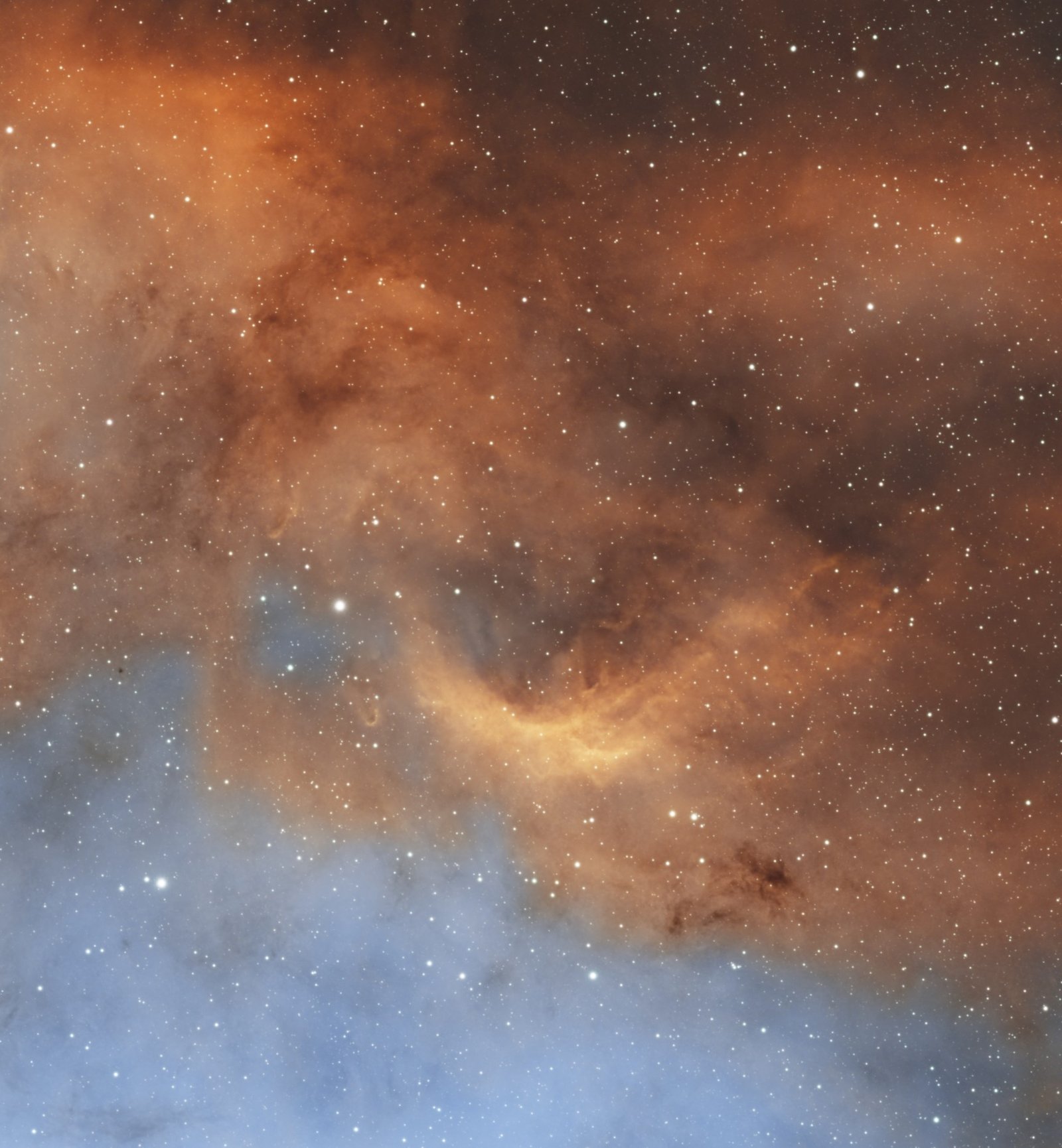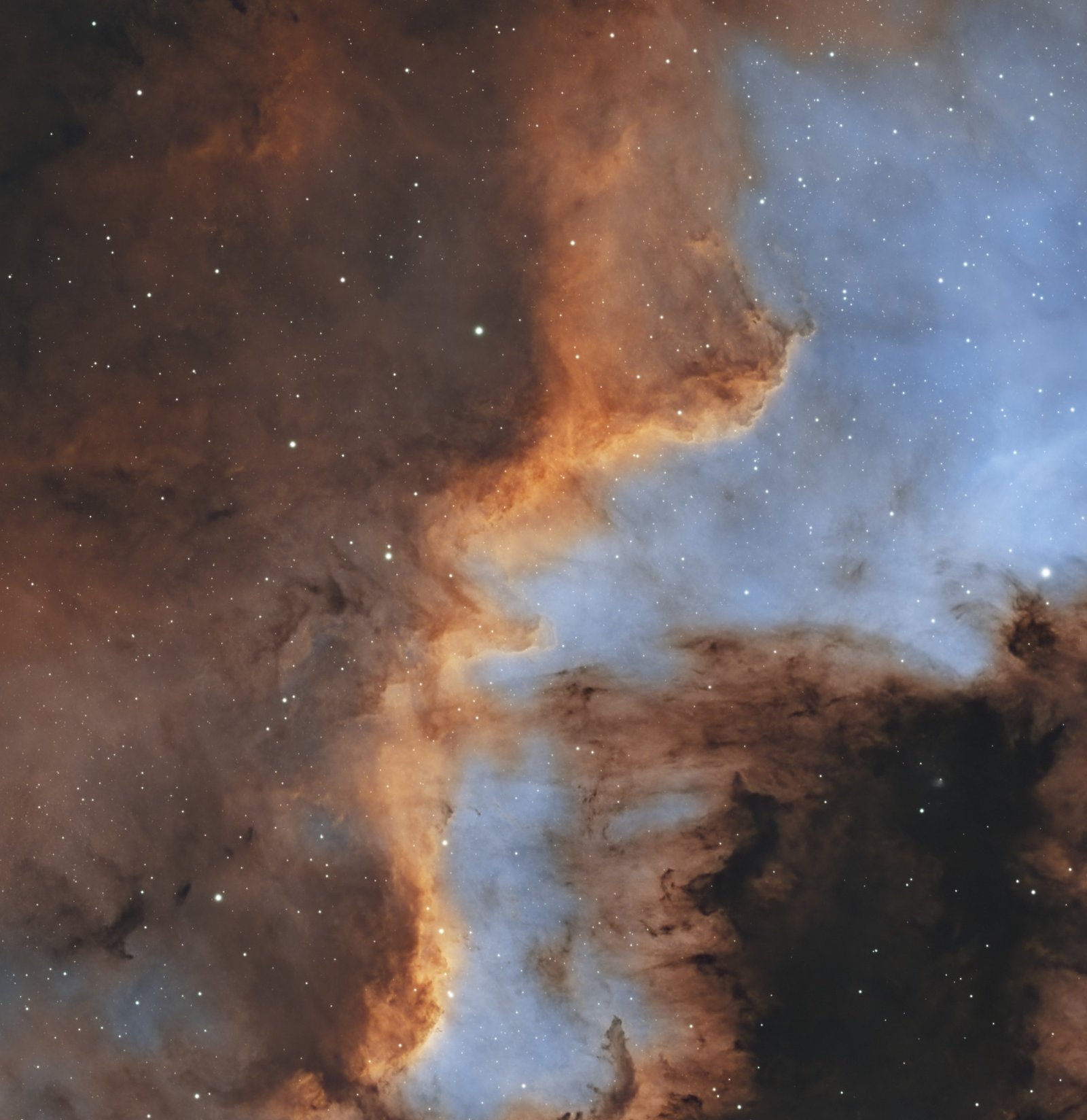
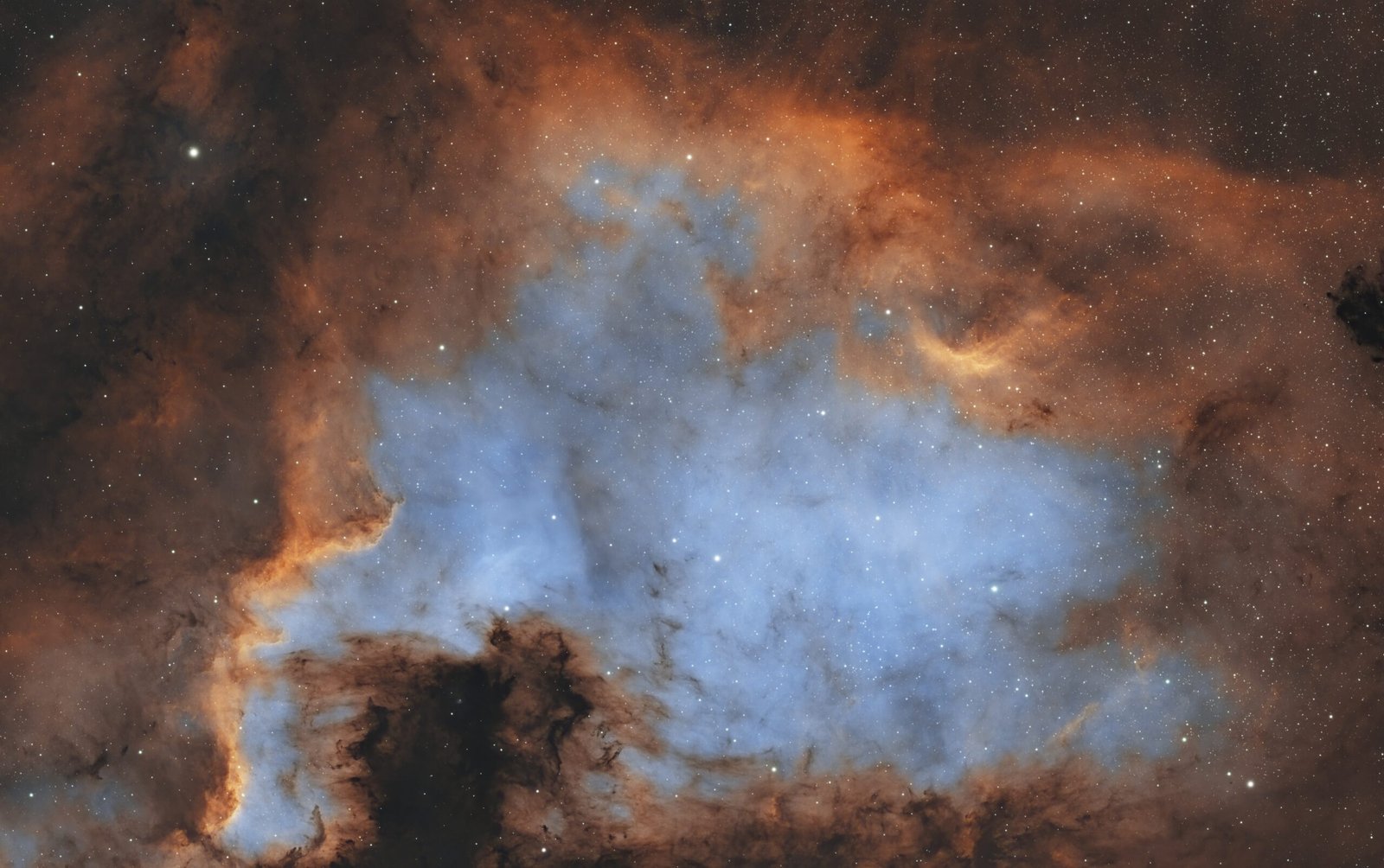
About the The North America Nebula
The North America Nebula (NGC 7000) is a vast cloud of glowing gas and dust in the constellation Cygnus, around 1,800 light-years from Earth. Its distinctive shape bears a remarkable resemblance to the continent of North America, complete with what looks like a coastline along its eastern edge. It was first recorded by astronomer William Herschel in 1786.Despite its familiar outline, this is no ordinary cloud. The nebula is an emission nebula, made primarily of hydrogen gas, with helium and traces of other elements, mixed with interstellar dust. Radiation from nearby hot stars energises the gas, causing it to glow. The red light often seen in astrophotography comes largely from hydrogen, while emissions from oxygen and other elements can reveal additional colours and structure.One of its most fascinating features is the Cygnus Wall, the bright, detailed region that resembles the eastern coast of North America. This is an active area of star formation, where dense clouds of gas and dust are being shaped by radiation from young stars. In other words, the nebula is not just beautiful to photograph; it is also a place where new stars are being born. <sup>2</sup>The distance is difficult to comprehend. The light reaching our cameras today began its journey around 1,800 years ago. When that light set off, the Roman Empire was still in existence in the West, and much of the world was living in a very different age.And what if we could travel there by road? If we somehow had a road stretching through space and could drive continuously at 70 miles per hour, it would take roughly 173 billion years to reach the nebula. That is more than twelve times the estimated age of the Universe. Thankfully, we have telescopes and cameras: we can explore these extraordinary places without leaving our own planet.For me, North American Nebula astrophotography is particularly rewarding. Its sweeping clouds, intricate dark dust lanes and bright regions of ionised gas offer a remarkable amount of detail to reveal in a long-exposure image. What appears at first to be a familiar shape is, in reality, an immense and dynamic stellar nursery hidden within our own Milky Way. More information from NASA here.
Capturing
The North America Nebula was captured over four nights in July 2026. Summer imaging in the UK can be a test of patience, with darkness arriving late, so some sessions ran until 2am as I tried to make the most of the available night sky.As with a few of my other targets, I got impatient to see the final result. I knew that collecting more data would almost certainly help bring out additional detail and improve the overall image, but I was keen to see what I could achieve with the data I already had.The final image was created from 83 exposures of 200 seconds each, giving a total integration time of 4 hours, 36 minutes and 40 seconds. Given more time under darker skies, I would like to revisit this target and see how much more detail I can reveal with additional integration.
Equipment Used
Processing
North America Nebula — From Linear Data to Final Image
See how the North America Nebula looked when first opened in PixInsight, compared with the finished image after processing.
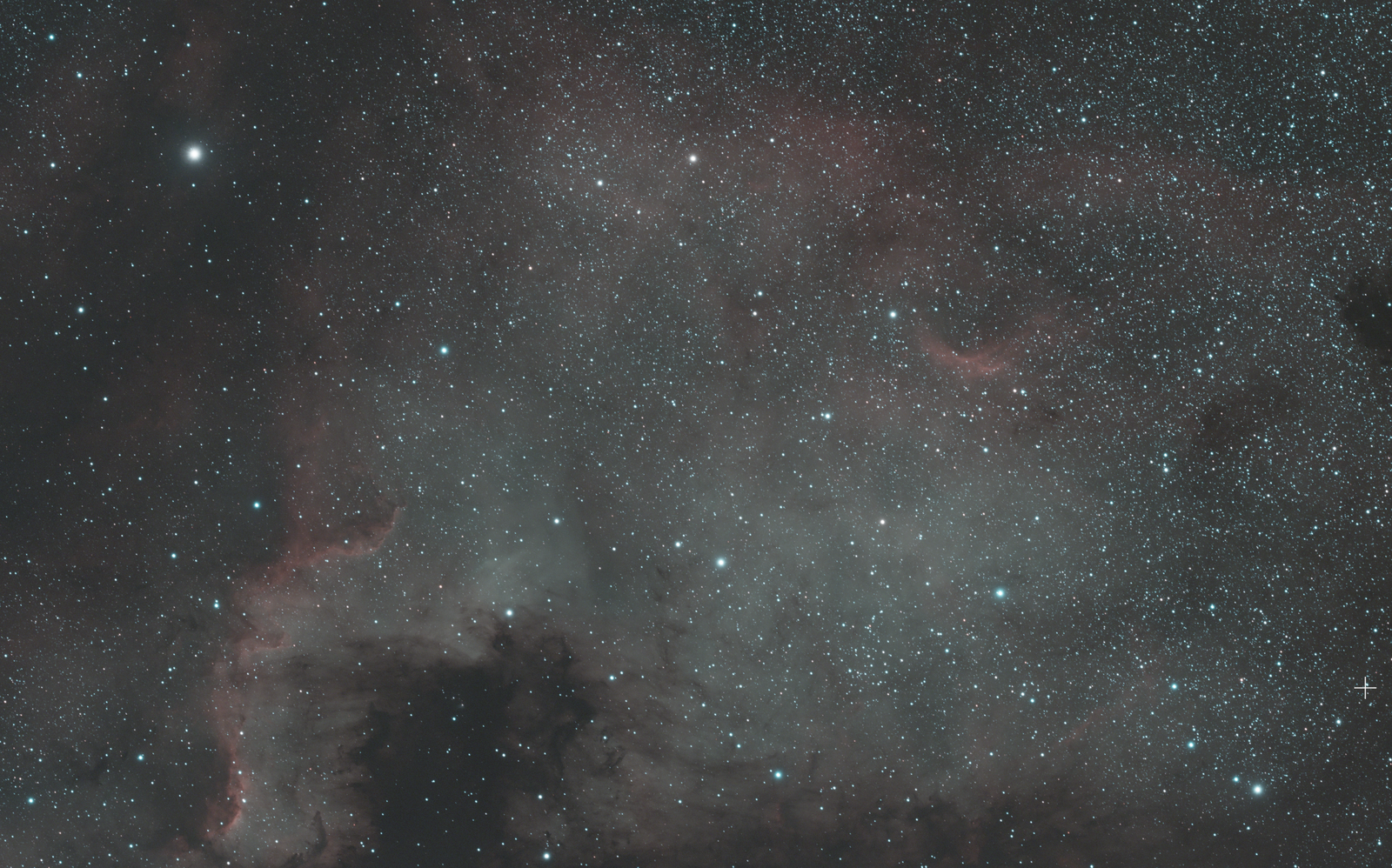
Raw astrophotography data can look dark and almost featureless when first opened. Processing reveals the faint nebular structures, colour and detail captured over the imaging session.
Close Up