About The Dark Shark Nebula
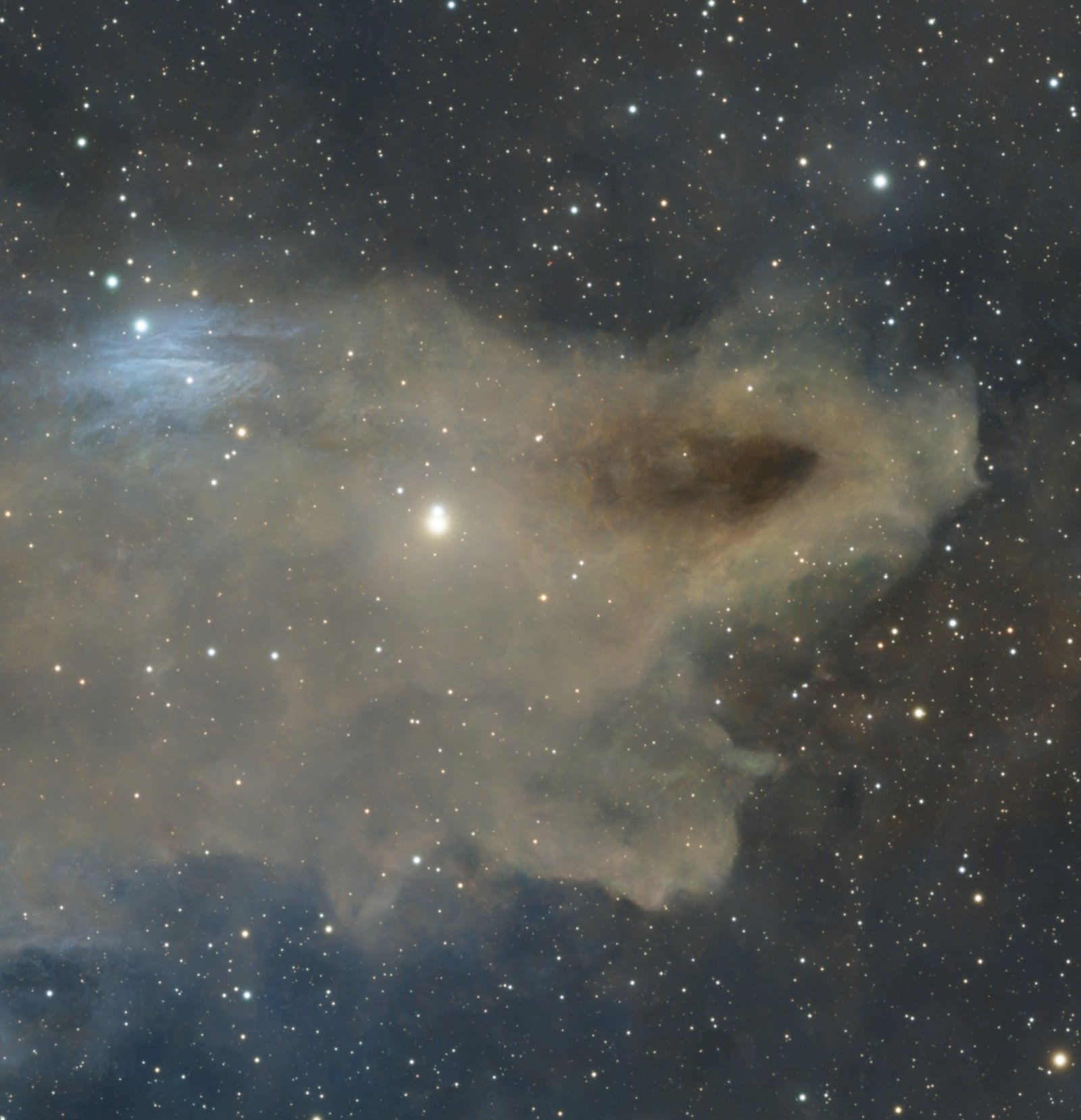
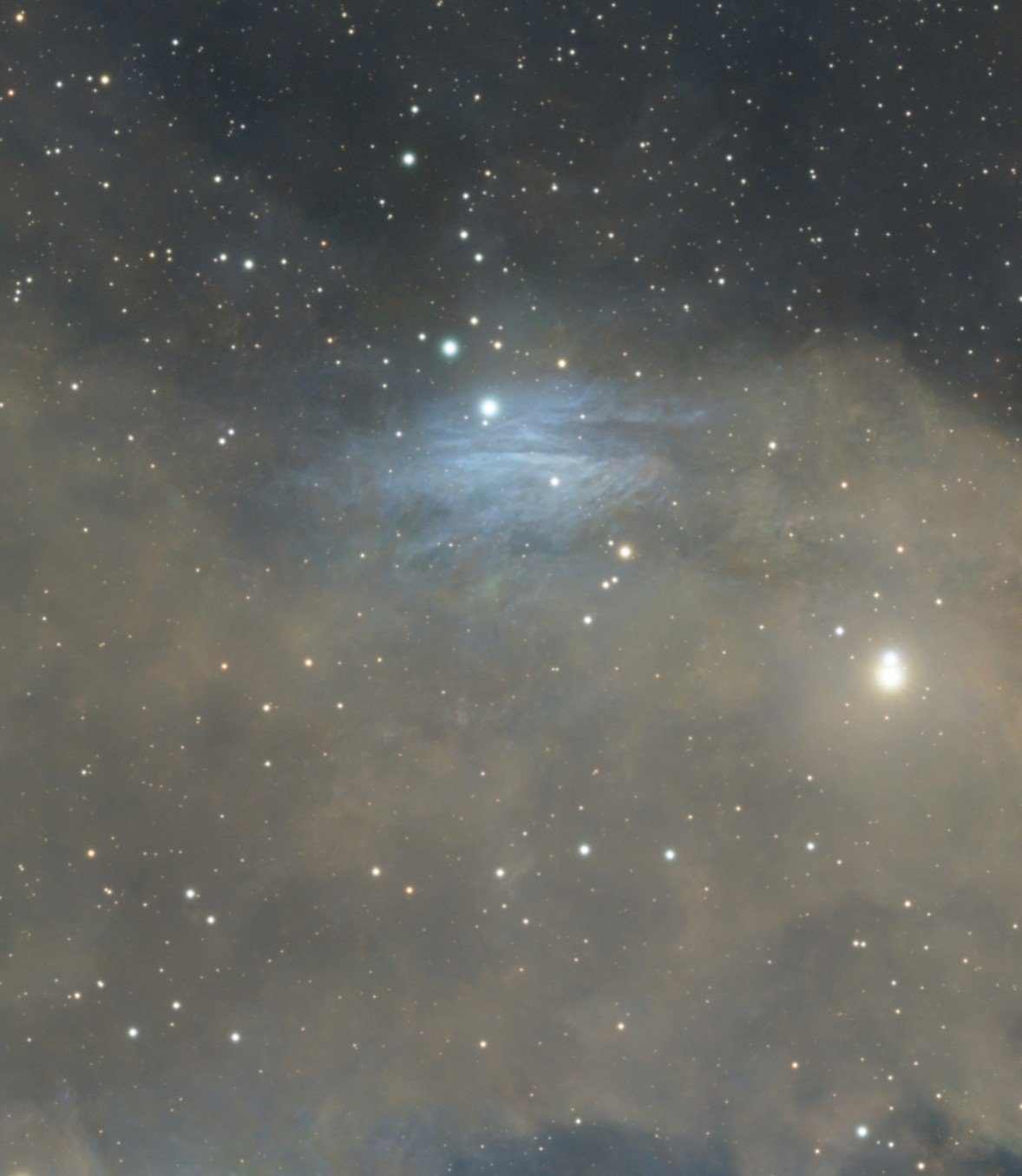
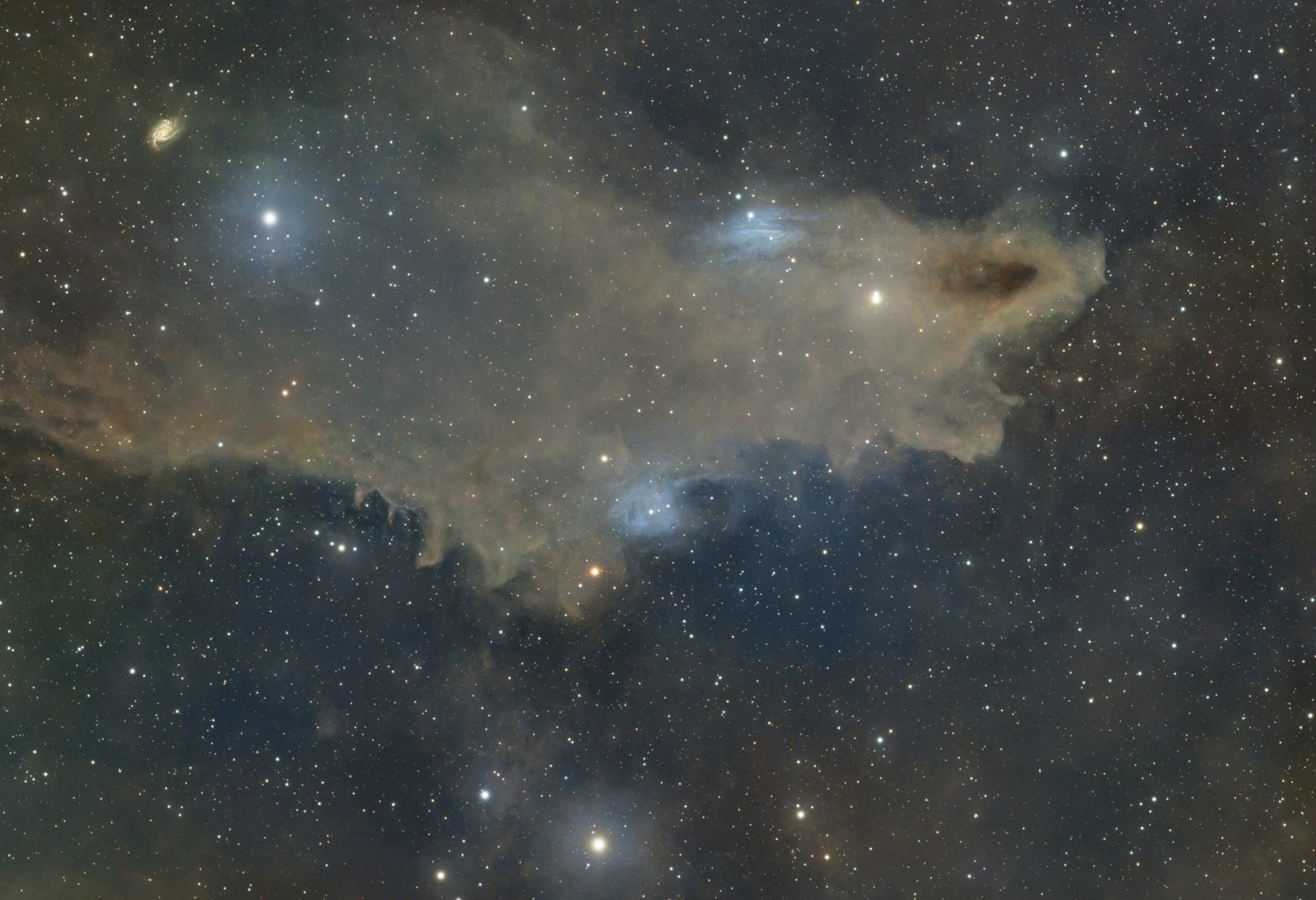
The Dark Shark Nebula (LDN 1235) lies approximately 650 light-years from Earth, in the northern constellation of Cepheus. Its distinctive shape resembles a shark drifting through a field of stars, but there is something rather more mysterious about this object than its name suggests. It is a vast cloud of cold interstellar dust and gas, stretching roughly 15 light-years from nose to tail. To put its distance into perspective, the light captured in this image began its journey around 650 years ago, when England was in the late Middle Ages. It has been travelling through space ever since, only now reaching my telescope on the west coast of England.Unlike a typical emission nebula, which glows as its gas is energised by nearby stars, a dark nebula reveals itself by doing almost the opposite: it blocks the light. Its dense dust absorbs and obscures the light from stars behind it, creating the dark, shadowy shapes that give the nebula its character. Within the wider region, there are also delicate blue reflection nebulae, where dust scatters the light of nearby stars. The result is a subtle mixture of darkness, starlight and faintly illuminated dust.The object was catalogued by astronomer Beverly T. Lynds in her Catalogue of Dark Nebulae, published in 1962. Although the catalogue is relatively recent in astronomical terms, the cloud itself has existed for far longer, quietly occupying its corner of the Milky Way.Why I Chose This TargetI wanted to try something a little different. Emission nebulae are often rewarding subjects for astrophotography, but dark nebulae present a different kind of challenge. Rather than capturing a bright cloud of glowing gas, you are trying to reveal something whose defining feature is the absence of light. Bringing out the faint dust without losing the delicate structure in the surrounding star field requires patience, careful capture and subtle processing.What attracted me most, though, was its appearance. The Dark Shark looks almost like smoke drifting through space, suspended against the stars. There is something wonderfully mysterious about it: a vast, silent cloud that cannot be seen directly, but whose presence is revealed by the light it hides. It has a certain romance to it, and I wanted to see whether I could capture some of that atmosphere in my own image. As a beginner, and for a first attempt, I am quite pleased with this result.
Capturing
CapturingThis image was captured over five nights in September 2026. As the nights gradually grew darker, I was able to spend more time collecting data, eventually building up a total of 142 exposures at 200 seconds each — just under eight hours of integration time.Framing the Dark Shark proved to be one of the biggest challenges. The Sky Atlas in the ASIAIR Mini didn't display a preview of the nebula, so I had to rely on the alignment of specific stars in my images, comparing their positions against Stellarium to work out where I was pointing. I had no way of knowing with any certainty whether I had framed the target correctly. It was essentially a leap of faith that I had captured most of the shark's distinctive shape.The preview images offered no visible hint of the nebula whatsoever. It wasn't until I completed my first processing attempt that I discovered I had managed to capture a reasonably well-framed image after all. I actually processed an initial four hours of data first, simply to check that I wasn't wasting several more nights on a target I had missed.In the end, I collected almost eight hours of data, but this is very much a work in progress. The Dark Shark could easily benefit from another 150 exposures, bringing the total to more than 16 hours and potentially revealing even more of the delicate structure and texture within the dust clouds.I got impatient, though, and wanted to see what I had captured.Fortunately, one of the great advantages of the ASIAIR Mini is its ability to return to precisely the same patch of sky and reproduce the framing from a previous session. That means I can revisit the Dark Shark, add more data and build on the image I already have.This is not the finished project. There is more detail to uncover, more texture to reveal, and another opportunity to see just how much of this mysterious cloud I can bring out.
Equipment Used
Processing
Close Up